Cox models
The Cox Proportional Hazards Model: Theory
The Cox Proportional Hazards Model [4] is a semi-parametric model used to analyze time-to-event data. It models the relationship between the survival time of an individual and a set of explanatory variables (covariates).
1. The Hazard Function
The model is defined by the hazard function, which describes the risk of an event occuring at time $t$, given that the event has not occured before the time $t$. The hazard function is given by:
\[h(t | \mathbf{X}) = h_0(t) \exp(\mathbf{X}^T\mathbf{\beta})\]
where:
- $h_0(t)$ is the baseline hazard function. This is an unspecified, non-negative function of time that represents the hazard for an individual with all covariates equal to zero. It captures the underlying risk profile common to all individuals.
- $\mathbf{X}$ is the covariate vector for an individual. These are the independent variables (e.g., age, treatment, gender) that influence the event time.
- $\mathbf{\beta}$ is the vector of regression coefficients.
The term $exp(\mathbf{X}^T\mathbf{\beta})$ is often called the hazard ratio.
The Baseline Hazard Function
How we saw before, $h_0(t)$ is the baseline hazard function. This is the hazard for when all the covariates are zero. The Cox model does not estimate it parametrically.
For predictions, we use the cumulative baseline hazard function: $H_0(t) = \int_0^t h_0(u) du$. It is estimated using the Breslow estimator :
\[\tilde{H}_0(t) = \sum_{t_i \le t} \frac{d_i}{\sum e^{(X\beta)}}\]
where:
- $d_i$ is the number of events that occur at time $t$
2. The Survival Function
The survival function, $S(t)$, which represents the probability that an individual survives beyond time $t$.
\[S(t | \mathbf{X}) = \exp\left(-\int_0^t h(u | \mathbf{X}) du\right)\]
After substituting the Cox hazard function:
\[S(t | \mathbf{X}) = \exp\left(-\exp(\mathbf{X}^\top \boldsymbol{\beta}) \int_0^t h_0(u) du\right)\]
with $H_0(t) = \int_0^t h_0(u) du$
Finally,
\[S(t | \mathbf{X}) = \exp\left(-\exp(\mathbf{X}^\top \boldsymbol{\beta}) H_0(t)\right)\]
3. The Full Likelihood Function
The full likelihood function includes the baseline hazard:
\[L(\boldsymbol{\beta}, h_0(\cdot)) = \prod_{i=1}^n \left( h(t_i | \mathbf{X}_i) \right)^{\Delta_i} S(t_i | \mathbf{X}_i)\]
with:
- $h(t_i | \mathbf{X}_i)$ for the individuals at risk of the event at time $t_i(\Delta_i=1)$
- $S(t_i | \mathbf{X}_i)$ for the individuals censored at time $t_i(\Delta_i=0)$
And if we substitute the hazard and survival function:
\[L(\boldsymbol{\beta}, h_0(\cdot)) = \prod_{i=1}^n \left( h_0(t_i) \exp(\mathbf{X}_i^\top \boldsymbol{\beta}) \right)^{\Delta_i} \exp\left(-\exp(\mathbf{X}_i^\top \boldsymbol{\beta}) H_0(t_i)\right)\]
4. The Partial-Likelihood Function
Since the baseline hazard function $h_0(t)$ is unspecified, a standard likelihood function cannot be formed directly. Instead, Cox introduced the concept of a partial likelihood. This approach focuses on the order of events rather than their exact timings, factoring out the unknown $h_0(t)$.
For each distinct observed event time $t_(j)$, we consider the set of individuals who are "at risk" of experiencing the event just before $t_(j)$. This is called the risk set, $R(t_(j))$. The partial likelihood is constructed by considering the probability that the specific individual(s) who experienced the event at $t_(j)$ were the ones to fail, given that some event occurred among the individuals in $R(t_(j))$. We can write this as follows: $P(\text{Individual } i \text{ fails at } t \mid \text{An event occurs in } R(t) \text{ at } t)$. Using the defintion of the conditional probability:
\[P(\text{Individual } i \text{ fails at } t \mid \text{An event occurs in } R(t) \text{ at } t) = \frac{P(\text{Individual } i \text{ fails at } t)}{\sum_{l \in R(t)} P(\text{Individual } l \text{ fails at } t)}\]
By substituting the hazard function and canceling out $h_0(t)$and $dt$:
\[\frac{h_i(t)dt}{\sum_{l \in R(t)} h_l(t)dt} = \frac{h_0(t)\exp(\mathbf{X}_i^T\mathbf{\beta})dt}{\sum_{l \in R(t)} h_0(t)\exp(\mathbf{X}_l^T\mathbf{\beta})dt} = \frac{\exp(\mathbf{X}_i^T\mathbf{\beta})}{\sum_{l \in R(t)} \exp(\mathbf{X}_l^T\mathbf{\beta})}\]
To have the partial likelihood, we will multiply the conditional probabilities for each time. For tied events, we used the Breslow approximation which says as follows: when $\Delta j$ individuals experience the event at the exact same time $t(j)$, the individuals are treated as if they failed simultaneously.
The partial-likelihood function for the Cox model, accounting for tied event times using Breslow's approximation, is given by:
\[L(\mathbf{\beta}) = \prod_{j=1}^{k} \left( \frac{\exp(\mathbf{X}_i^T\mathbf{\beta})}{ \sum_{l \in R_j} \exp(\mathbf{X}_l^T\mathbf{\beta})}\right)^{\Delta_i}\]
where:
- $k$ is the number of distinct event times.
- $t_{(j)}$ denotes the j-th distinct ordered event time.
- $\Delta_j$ is the set of individuals who experience the event at time $t_{(j)}$.
- $R_j$ is the risk set at time $t_{(j)}$, comprising all individuals who are still at risk (have not yet experienced the event or been censored) just- before $t_{(j)}$.
- $\mathbf{X}_i$ is the covariate vector for individual $i$.
5. The Loss Function (Negative Log-Partial-Likelihood)
Our goal is to estimate the regression coefficients $\mathbf{\beta}$ by maximizing the partial-likelihood function $L(\mathbf{\beta})$. Equivalently, it is often more convenient to minimize its negative logarithm, which we define as our loss function:
\[\text{Loss}(\mathbf{\beta}) = - \log L(\mathbf{\beta}) \]
Taking the negative logarithm of the Breslow partial likelihood, we get:
\[ \text{Loss}(\mathbf{\beta}) = - \sum_{i=1}^{n} \Delta_i \left( \mathbf{X}_i^T\mathbf{\beta} - \log \left( \sum_{j \in R_j} \exp(\mathbf{X}_j^T\mathbf{\beta}) \right) \right) \]
This function is convex, which facilitates optimization.
The loss function is coded as follows:
function loss(beta, M::Cox)
    # M.X: Design matrix (n x m), where n is number of observations, m is number of covariates.
    # M.T: Vector of observed times (n) for each individual.
    # M.Δ: Vector of event indicators (n), 1 if event, 0 if censored.
    η = M.X*beta
    return dot(M.Δ, log.((M.T .<= M.T') * exp.(η)) .- η)
end
6. Gradient of the Loss Function
To find the optimal $\mathbf{\beta}$, we need to minimize the loss function.
The gradient of the loss function with respect to a specific coefficient $\beta_k$ is:
\[\frac{\partial}{\partial \beta_k} \text{Loss}(\mathbf{\beta}) = - \sum_{i=1}^{n} \left( X_{ik} - \frac{\sum_{j \in R_i} \exp(\mathbf{\beta}^T\mathbf{X}_j) X_{jk}}{\sum_{j \in R_i} \exp(\mathbf{\beta}^T\mathbf{X}_j)} \right)\]
7. Hessian Matrix of the Loss Function
For optimization algorithms like Newton-Raphson and for calculating standard errors, the Hessian matrix (matrix of second partial derivatives) of the loss function is required.
The entry for the $k$-th row and $l$-th column of the Hessian matrix is:
\[\frac{\partial^2}{\partial \beta_k \partial \beta_l} \text{Loss}(\mathbf{\beta}) = \sum_{i=1}^{n} \Delta_i \left[ \frac{\sum_{j \in R_i} \exp(\mathbf{\beta}^T\mathbf{X}_j) X_{jk}X_{jl}}{\sum_{j \in R_i} \exp(\mathbf{\beta}^T\mathbf{X}_j)} - \frac{\left( \sum_{j \in R_i} \exp(\mathbf{\beta}^T\mathbf{X}_j) X_{jk} \right) \left( \sum_{j \in R_i} \exp(\mathbf{\beta}^T\mathbf{X}_j) X_{jl} \right)}{\left( \sum_{j \in R_i} \exp(\mathbf{\beta}^T\mathbf{X}_j) \right)^2} \right]\]
8. Information Matrix and Variance-Covariance Matrix
The observed Information Matrix, $I(\hat{\boldsymbol{\beta}})$, is defined as the negative of the Hessian matrix of the log-likelihood function, evaluated at the maximum likelihood estimates $\hat{\boldsymbol{\beta}}$.
\[I(\hat{\boldsymbol{\beta}}) = -H(\hat{\boldsymbol{\beta}})\]
But, in the earlier formula, $\mathbf{H}_{\text{Loss}}$ was for Loss(β), which is -log L(β) $\mathbf{H}_{\text{Loss}} = - \mathbf{H}_{\text{log-likelihood}}$. Therefore, the observed Information Matrix is equal to $\mathbf{H}_{\text{Loss}}$ itself.
The variance (and covariance) of our estimators $\hat{\boldsymbol{\beta}}$ are obtained by inverting the observed information matrix.
\[\text{Var}(\hat{\boldsymbol{\beta}}) = I(\hat{\boldsymbol{\beta}})^{-1}\]
This final matrix contains:
- On its diagonal: the variances of each coefficient ($\text{Var}(\hat{\beta}_1)$, $\text{Var}(\hat{\beta}_2)$, ...).
- Off-diagonal: the covariances between pairs of coefficients.
9. Standard Error
The standard error for a specific coefficient ($\hat{\beta}_k$) is the square root of its variance.
\[SE(\hat{\beta}_k) = \sqrt{\text{Var}(\hat{\beta}_k)}\]
10. Wald Test for Significance
To determine if a variable has a statistically significant effect, a Wald test is performed. A z-score is calculated:
\[z = \frac{\text{Coefficient}}{\text{Erreur Type}} = \frac{\hat{\beta}}{SE(\hat{\beta})}\]
This $z$-score is then compared to a normal distribution to obtain a $p$-value. A low $p$-value (typically < 0.05) suggests that the coefficient is significantly different from zero.
The p-value for each coefficient is calculated by comparing its z-score to a standard normal distribution. This p-value indicates the probability of observing a z-score as extreme as, or more extreme than, the one calculated, assuming the null hypothesis (that the coefficient is zero) is true.
11. Confidence Interval
The standard error allows for the construction of a confidence interval (CI) around the coefficient, which provides a range of plausible values for the true coefficient.
The general formula for a $(1 - \alpha) \times 100\%$ confidence interval is:
\[\text{IC pour } \hat{\beta} = \hat{\beta} \pm z_{\alpha/2} \times SE(\hat{\beta})\]
Let us see for example the output on the colon dataset:
using SurvivalModels
using RDatasets

# ovarian = dataset("survival", "ovarian")
# ovarian.FUTime = Float64.(ovarian.FUTime)
# ovarian.FUStat = Bool.(ovarian.FUStat)
# model = fit(Cox, @formula(Surv(FUTime, FUStat) ~ Age + ECOG_PS), ovarian)

colon = dataset("survival", "colon")
colon.Time = Float64.(colon.Time)
colon.Status = Bool.(colon.Status)
model_colon = fit(Cox, @formula(Surv(Time, Status) ~ Age + Rx), colon)
coeftable(model_colon)
| | Coef. | Std. Error | z | Pr(>|z|) | exp(coef) | Lower 95% | Upper 95% | |:––––––|––––––:|–––––-:|–––:|:––––-|:–––––|–––––:|–––––:| | Age | -0.00205614 | 0.00280669 | -0.73 | 0.4638 | 0.997946 | 0.992471 | 1.00345 | | Rx: Lev | -0.0200488 | 0.0768372 | -0.26 | 0.7942 | 0.980151 | 0.843119 | 1.13945 | | Rx: Lev+5FU | -0.439289 | 0.0839364 | -5.23 | <1e-06 | 0.644494 | 0.546729 | 0.759742 |
The table has one row per coefficient with the estimate (log hazard ratio), its standard error, the Wald z statistic and p-value, the hazard ratio exp(coef), and the confidence interval for the hazard ratio.
SurvivalModels.CoxMethod — Type
StatsBase.fit(Cox, @formula(Surv(T,Δ)~predictors), dataset)Arguments:
- Cox: The model to fit, e.g. Cox. Could be specified to any of
CoxNM, CoxOptim, CoxApproxorCoxDefaultif you want different sovers to be used, see their own documentations. Default isCoxDefault. - formula: A StatsModels.FormulaTerm specifying the survival model
- df: A DataFrame containing the variables specified in the formula
Returns:
predictor: A Vector{String} containing the names of the predictor variables included in the model
beta: A Vector{Float64} containing the estimated regression coefficients (β) for each predictor
se: A Vector{Float64} containing the standard errors of the estimated regression coefficients
loglikelihood: A Vector{Float64} containing the log-likelihood of the fitted model. This value is repeated for each predictor row
coef: A vector of the estimated coefficients
formula: The applied formula
Example:
ovarian = dataset("survival", "ovarian")
ovarian.FUTime = Float64.(ovarian.FUTime) (Time column needs to be Float64 type)
ovarian.FUStat = Bool.(ovarian.FUStat) (Status column needs to be Bool type)
model = fit(Cox, @formula(Surv(FUTime, FUStat) ~ Age + ECOG_PS), ovarian)
We need to add details about the different prediction types here.
Types:
- Cox : the base abstract type
- CoxGrad<:Cox : abstract type for Cox models that are solved using gradient-based optimization
- CoxLLH<:CoxGrad : abstract type for Cox models that are solved by optimizing the log-likelihood
Coefficient Table & Extraction
coeftable(model) returns the inference table above; confint(model) returns the coefficient confidence intervals as a DataFrame for programmatic use. Both take a level keyword (default 0.95).
StatsAPI.coeftable — Method
coeftable(model::Cox; level::Real=0.95)Wald coefficient table for a fitted Cox model: the coefficient (log hazard ratio), its standard error, the z statistic, the two-sided p-value, the hazard ratio exp(coef), and the confidence interval for the hazard ratio at confidence level level (matching R's summary(coxph) convention).
StatsAPI.confint — Method
confint(model::Cox; level::Real=0.95)Wald confidence intervals for the coefficients (log-hazard-ratio scale) at confidence level level. Returns a DataFrame with columns term, lower, upper.
12. Prediction Interface
After fitting a Cox model, you can obtain various types of predictions using the predict function:
predict(model, :lp)              # Linear predictor (default)
predict(model, :risk)            # Relative risk (exp(linear predictor))
predict(model, :expected)        # Cumulative hazard at each subject's own time Tᵢ
predict(model, :survival)        # Survival probability at each subject's own time Tᵢ
predict(model, :terms)           # Contribution of each term to the linear predictor

predict(model, :expected, t)     # Cumulative hazard for every subject at scalar time t
predict(model, :survival, t)
predict(model, :expected, ts)    # Matrix (n × length(ts)) over a vector of times
predict(model, :survival, ts)
Available types:
:lp— Linear predictor (Xβ):risk— Relative risk, exp(Xβ):expected— Expected cumulative hazard:survival— Survival probability:terms— Covariate-wise contributions to the linear predictor
Output shapes for :expected and :survival:
- No time argument → length-
nvector, with each subject evaluated at their own observed timeTᵢ. This matches R'spredict(coxph, type="expected")/type="survival"convention. t::Real→ length-nvector at the scalar time.ts::AbstractVector→n × length(ts)matrix.
Passing a time argument with :lp, :risk, or :terms is an error — those types do not depend on time.
Predict on new data
Each type accepts a newdata::DataFrame argument. The fitted formula's schema is re-applied to newdata to build the new design matrix, so newdata must contain every predictor column referenced in the original @formula(...). Centering is against the training reference subject (continuous covariates at their training mean, categorical at their training mode) — so predictions made on newdata are on the same absolute scale as the no-newdata path.
predict(model, :lp,    newdata)             # length-n_new vector
predict(model, :risk,  newdata)             # length-n_new vector
predict(model, :terms, newdata)             # n_new × p matrix
predict(model, :expected, newdata, t)       # length-n_new at scalar t
predict(model, :survival, newdata, t)
predict(model, :expected, newdata, ts)      # n_new × length(ts) matrix
predict(model, :survival, newdata, ts)
:expected and :survival on newdata require an explicit time argument — there is no "own time" default for arbitrary new subjects. Passing a time with :lp / :risk / :terms errors.
SurvivalModels.predict_expected — Method
predict_expected(C::Cox)
predict_expected(C::Cox, t::Real)
predict_expected(C::Cox, ts::AbstractVector)
Cumulative hazard Λᵢ(t) = Λ₀(t) · exp(ηᵢ) per subject, where Λ₀ is the Breslow estimator centered to the fit's reference (continuous covariates at their mean, categorical at their mode) and ηᵢ = (Xᵢ - X̄) β.
Output shape:
- no time argument → length-
nvector with each subject evaluated at their own observed timeTᵢ(the convention used by R'spredict(coxph, type="expected")); t::Real→ length-nvector at the scalar time;ts::AbstractVector→n × length(ts)matrix.
SurvivalModels.predict_expected — Method
predict_expected(C::Cox, newdata::DataFrame, t::Real)
predict_expected(C::Cox, newdata::DataFrame, ts::AbstractVector)
Per-subject cumulative hazard Λᵢ(t) for subjects in newdata evaluated at user-supplied times. Length-n_new vector for scalar t; n_new × length(ts) matrix for a vector. Centred against the training reference subject so the absolute scale matches the no-newdata path. Newdata predictions require an explicit time argument — there is no "own time" default for arbitrary new subjects.
SurvivalModels.predict_survival — Method
predict_survival(C::Cox)
predict_survival(C::Cox, t::Real)
predict_survival(C::Cox, ts::AbstractVector)
Per-subject survival probability Sᵢ(t) = exp(-Λᵢ(t)) derived from predict_expected. Shapes match predict_expected: the no-argument form returns a length-n vector with each subject at their own observed time Tᵢ; the t::Real form is a length-n vector at a scalar time; the ts::AbstractVector form is an n × length(ts) matrix.
SurvivalModels.predict_survival — Method
predict_survival(C::Cox, newdata::DataFrame, t::Real)
predict_survival(C::Cox, newdata::DataFrame, ts::AbstractVector)
Per-subject survival probability Sᵢ(t) = exp(-Λᵢ(t)) on newdata at user times. Shapes match predict_expected.
Example: Prediction on New Data
The following example is drawn from this article.
    using DataFrames, SurvivalModels

    df = DataFrame(
        time = [1.0, 3.0, 5.0, 6.0, 2.0, 7.0, 9.0, 11.0],
        status = [true, false, true, true, true, false, true, true],
        sex = [:male, :male, :male, :male, :female, :female, :female, :female],
        age = [57, 52, 48, 42, 39, 31, 26, 22],
    )
    model = fit(Cox, @formula(Surv(time, status) ~ age + sex), df)
Cox model (method: CoxDefault)
n: 8, events: 6
log-likelihood: -2.4048, AIC: 8.8096, BIC: 8.9685
coefficients:
age 0.63382
sex: male -7.4936
You can extract the baseline haard, centered or not, with the following:
SurvivalModels.baseline_hazard(model, centered = false)8-element Vector{Float64}:
3.4424556285043997e-13
5.942770374703066e-12
5.942770374703066e-12
1.0965739923044279e-10
1.8972983721645534e-9
1.8972983721645534e-9
6.646861703876311e-8
9.459173599386564e-7 SurvivalModels.baseline_hazard(model, centered = true)8-element Vector{Float64}:
0.027808077917814818
0.4800556331330888
0.4800556331330888
8.858099656581187
153.26332903066987
153.26332903066987
5369.31969841062
76410.98822358932And then each of the prediction type can be accessed as follows:
predict(model, :lp)8-element Vector{Float64}:
3.5189684309689433
0.34988421408591464
-2.185383159420514
-5.98828421968015
-0.3961355271103777
-5.466670274123228
-8.635754491006256
-11.171021864512682 predict(model, :risk)8-element Vector{Float64}:
33.749595463125615
1.4189032500719052
0.11243464500647969
0.0025079634750864986
0.6729154914651001
0.004225277777741304
0.00017763947357070042
1.4076245966063964e-5 predict(model, :terms)8×2 Matrix{Float64}:
11.0126 -7.4936
7.84348 -7.4936
5.30822 -7.4936
1.50532 -7.4936
-0.396136 0.0
-5.46667 0.0
-8.63575 0.0
-11.171 0.0 predict(model, :expected)8-element Vector{Float64}:
0.9385113803333266
0.6811524980678659
0.9959572903197255
0.38437883127908423
0.3230368723003422
0.6475801382959431
0.9538031246584544
1.0755798647452601 predict(model, :survival)8-element Vector{Float64}:
0.3912097646648285
0.506033453588987
0.36936968122373826
0.6808734421592472
0.7239471602786564
0.5233105850573463
0.38527299245365143
0.34109990613348057Evaluate at arbitrary times:
predict(model, :survival, 5.0)8-element Vector{Float64}:
1.4605047681215294e-130
3.4789278797228036e-6
0.36936968122373826
0.9780291629766359
0.002577971360151607
0.9632638360720057
0.9984276892179642
0.9998753189837661 predict(model, :survival, [1.0, 5.0, 10.0])8×3 Matrix{Float64}:
0.39121 1.4605e-130 0.0
0.961311 3.47893e-6 0.0
0.996878 0.36937 6.56876e-263
0.99993 0.978029 1.41829e-6
0.981462 0.00257797 0.0
0.999883 0.963264 1.40352e-10
0.999995 0.998428 0.385273
1.0 0.999875 0.927206Different versions of the optimisation routine
To implement the Cox proportional hazards model, different versions were coded, using different methods. The final goal is to compare these versions and choose the most efficient one: the fastest and the closest to the true values of the coefficients.
V0: Derivative-Free Optimization with Nelder-Mead
SurvivalModels.CoxNM — Type
CoxNM(T, Δ, X)
fit(CoxNM, @formula(Surv(T,Δ)~X), data = ...)
An implementation of the Cox proportional hazards model that minimizes the negative partial log-likelihood function (cox_nllh). This version uses the Nelder-Mead method, a derivative-free optimization algorithm.
Fields:
- X::Matrix{Float64}: The design matrix of covariates, where rows correspond to individuals and columns to features
- T::Vector{Float64}: The observed times, sorted in ascending order
- Δ::Vector{Bool}: The event indicator vector (true for event, false for censoring)
V1: Implementation using the 'Optimization.jl' Julia package
SurvivalModels.CoxOptim — Type
CoxOptim(T, Δ, X)
fit(CoxOptim, @formula(Surv(T,Δ)~X), data = ...)
The first implementation of the Cox proportional hazards model uses Optim.jl for coefficient estimation. It uses the BFGS algorithm (with forward-mode automatic differentiation) to minimize the negative partial log-likelihood.
Fields:
- X::Matrix{Float64}: The design matrix of covariates, where rows correspond to individuals and columns to features.
- T::Vector{Float64}: The observed times, sorted in ascending order
- Δ::Vector{Int64}: The event indicator vector (true for event, false for censoring)
V2: Implementation using the gradient and the Hessian matrix
For this version the Hessian Matrix was directly implemented. Its complexity is O(n2m2) which makes it the slowest version.
SurvivalModels.CoxHessian — Type
CoxHessian(T, Δ, X)
fit(CoxHessian, @formula(Surv(T,Δ)~X), data = ...)
The second implementation of the Cox proportional hazards model uses a Newton-Raphson-like iterative update that directly calculates and utilizes the gradient and Hessian matrix. This version is updating coefficients via the update! function.
Fields:
- X::Matrix{Float64}: The design matrix of covariates, where rows correspond to individuals and columns to features
- T::Vector{Float64}: The observed times, sorted in ascending order
- Δ::Vector{Int64}: The event indicator vector (true for event, false for censoring)
- R::BitMatrix: A boolean risk matrix, where 'R[i,j]' is 'true' if individual 'j' is at risk at time 'T[i]'
V3: Improved version of V2 (much faster) because non-allocative.
SurvivalModels.CoxDefault — Type
CoxDefault(T, Δ, X)
fit(CoxDefault, @formula(Surv(T,Δ)~X), data = ...)
fit(Cox, @formula(Surv(T,Δ)~X), data = ...)
The third implementation of the Cox proportional hazards model represents a highly optimized and significantly faster iteration compared to previous implementation, CoxV2.
This is the default implementation called when you ask for a Cox model.
Fields:
- Xᵗ::Matrix{Float64}: The design matrix of covariates, transposed (m rows, n columns)
- sX::Vector{Float64}: Sum of X' multiplied by Δ
- T::Vector{Float64}: The observed times sorted in descending order
- Δ::Vector{Bool}: The event indicator vector (true for event, false for censoring)
- loss::Vector{Float64}: Stores the current negative partial log-likelihood value
- G::Vector{Float64}: Stores the gradient vector
- H::Matrix{Float64}: Stores the Hessian matrix
- S₁::Vector{Float64}: Sum of rⱼxₖⱼ
- S₂::Matrix{Float64}: Sum of rⱼxₖⱼ * xⱼ
- μ::Vector{Float64}: Updates the gradient and Hessian
- η::Vector{Float64}: ηi = Xiβ
- r::Vector{Float64}: ri = exp(ηi)
- R::Vector{UnitRange{Int64}}: A vector of the risk ranges for each output time.
V4: Majoration of the Hessian matrix by a universal bound.
Coding the Hessian Matrix for the CoxHessian was very impractical, so for this version we tried a different approach:
The Hessian Matrix simplifies for the diagonal terms as folllows:
\[\frac{\partial^2 \text{Loss}(\mathbf{\beta})}{\partial \beta_k^2} = \sum_{i=1}^{n} \Delta_i \left[ \frac{\sum_{j \in R_i} \exp(\mathbf{\beta}^T\mathbf{X}_j) X_{jk}^2}{\sum_{j \in R_i} \exp(\mathbf{\beta}^T\mathbf{X}_j)} - \left( \frac{\sum_{j \in R_i} \exp(\mathbf{\beta}^T\mathbf{X}_j) X_{jk}}{\sum_{j \in R_i} \exp(\mathbf{\beta}^T\mathbf{X}_j)} \right)^2 \right]\]
This can be expressed using the concept of variance.
\[\frac{\partial^2 \text{Loss}(\mathbf{\beta})}{\partial \beta_k^2} = \sum_{i=1}^{n} \Delta_i \left[ \sum_{j \in R_i} A_j X_{jk}^2 - \left( \sum_{j \in R_i} A_j X_{jk} \right)^2 \right]\]
with:
\[A_{j} = \frac{\exp(\mathbf{\beta}^T\mathbf{X}_j)}{\sum_{j \in R_i} \exp(\mathbf{\beta}^T\mathbf{X}_j)}\]
The upper bound for the variance of a variable $X$ on an interval $[a,b]$ is given by:
\[\text{Var}(X) \le \frac{1}{4}(b-a)^2\]
Applying this bound to the diagonal Hessian elements, we get an approximation for the k-th diagonal element, B_k:
\[B_k = \sum_{i=1}^n \frac{1}{4} \Delta_i \left( \max_{j \in R_i} X_{jk} - \min_{j \in R_i} X_{jk} \right)^2\]
SurvivalModels.CoxApprox — Type
CoxApprox(T, Δ, X)
fit(CoxApprox, @formula(Surv(T,Δ)~X), data = ...)
The fourth implementation of the Cox proportional hazards model uses Hessian approximation based on a pre-calculated estimation. This version was created for when it might be difficult to work with full Hessian , offering faster iterations by using a Hessian approximation.
Fields:
- X::Matrix{Float64}: The design matrix of covariates, where rows correspond to individuals and columns to features
- T::Vector{Float64}: The observed times sorted in ascending order
- Δ::Vector{Bool}: The event indicator vector (true for event, false for censoring)
- sX::Vector{Float64}: Sum of X' multiplied by Δ
- G::Vector{Float64}: Stores the gradient vector
- η::Vector{Float64}: ηi = Xiβ
- A::Vector{Float64}: Ai = exp(ηi)
- B::Vector{Float64}: Stores the majoration elements of the Hessian matrix
- C::Vector{Float64}: Used in the mkA! function
- K::Vector{Int64}: Number of events at each unique observed event time
- loss::Vector{Float64}: Stores the current negative partial log-likelihood value, used in CoxLLH getβ
Comparison of the different methods speed
We propose to compare the different methods on simulated data, with varying number of lines and columns, to verify empirically the theoretical complexity of the different methods. We will then compare the results with Julia's and R's existing Cox implementation.
We will start by coding our Julia and R structures:
using SurvivalModels, Plots, Random, Distributions, StatsBase, LinearAlgebra, DataFrames, RCall, Survival
using SurvivalModels: getβ, CoxNM, CoxOptim, CoxHessian, CoxDefault, CoxApprox
Precompiling packages...
✗ Conda
0 dependencies successfully precompiled in 2 seconds. 82 already precompiled.We add specific code to compare with Survival.jl and also R::survival::coxph():
struct CoxVJ<:SurvivalModels.CoxMethod
    T::Vector{Float64}
    Δ::Vector{Bool}
    X::Matrix{Float64}
    function CoxVJ(T,Δ,X)
        new(T,Bool.(Δ),X)
    end
end

function SurvivalModels.getβ(M::CoxVJ)
    return fit(Survival.CoxModel, M.X, Survival.EventTime.(M.T,M.Δ)).β
end

R"""
library(survival)
"""

struct CoxVR<:SurvivalModels.CoxMethod
    df::DataFrame
    function CoxVR(T,Δ,X)
        df = DataFrame(X,:auto)
        df.status = Δ
        df.time = T
        new(df)
    end
end

function SurvivalModels.getβ(M::CoxVR)
    df = M.df
    @rput df
    R"""
    beta  <- coxph(Surv(time,status)~., data = df, ties="breslow")$coefficients
    """
    @rget beta
    return beta
end
Then, we will simulate our data and then run our models:
# Creating a dictionary for all the models:
# Label => (constructor, plotting color)

const design = Dict(
"CoxNM"=> (CoxNM, :blue),
"CoxOptim"=> (CoxOptim, :orange),
"CoxHessian"=> (CoxHessian, :brown),
"CoxDefault"=> (CoxDefault, :purple),
"CoxApprox"=> (CoxApprox, :green),
"VR"=> (CoxVR, :red),
"VJ"=> (CoxVJ, :black)
);


function simulate_survival_data(n, m; β=ones(m))
    X = randn(n,m)
    O = rand.(Exponential.(exp.(.- X * β)))
    C = rand(Exponential(1/3),n)
    T = min.(O, C)
    Δ = Bool.(O .<= C)
    return (T, Δ, X)
end

# Run the models and get the running time, the β coefficients and the difference between the true β and the obtained ones:
function run_models()
    Ns = (1000, 2000, 4000)
    Ms = (5,10,20)
    true_betas = randn(maximum(Ms))
    df = []
    for n in Ns, m in Ms
        if (n == 2000) | (m == 10) # Only if they end up in the graphs.
            data = simulate_survival_data(n,m, β = true_betas[1:m])
            for (name, (constructor, _)) in design
                display((n,m,name))
                model = constructor(data...)
                beta = getβ(model)
                time = @elapsed getβ(model)
                push!(df, (
                    n = n,
                    m = m,
                    name = name,
                    time = time,
                    beta = beta,
                    diff_to_truth = sqrt(sum((beta .- true_betas[1:m]).^2)/sum(true_betas[1:m].^2)),
                ))
            end
        end
    end
    df = DataFrame(df)
    sort!(df, :name)
    return df
end
run_models (generic function with 1 method)The first graph will compare how long it takes for all the implementations to run on datasets that have maximum 2000 observations and 20 covariates.
# Plot the results, starting with the time:
function timing_graph(df)
    group1 = groupby(filter(r -> r.m==10, df), :name)
    p1 = plot(; xlabel = "Number of observations (n)",
        ylabel = "Time (in seconds)",
        yscale= :log10,
        xscale= :log10,
        title = "For m=20 covs., varying n",
        legend = :bottomright,
        lw = 1);
    for g in group1
        plot!(p1, g.n, g.time, label = g.name[1] , color = design[g.name[1]][2], marker = :circle, markersize = 3)
    end
    group2 = groupby(filter(r -> r.n==2000, df), :name)
        p2 = plot(; xlabel = "Number of covariates (m)",
            ylabel = "Temps (ms)",
            yscale= :log10,
            xscale= :log10,
            title = "For n=2000 obs., varying m",
            legend = :bottomright,
            lw = 1);
        for g in group2
            plot!(p2, g.m, g.time, label = g.name[1] , color = design[g.name[1]][2], marker = :circle, markersize = 3)
        end
        p = plot(p1,p2, size=(1200,600), plot_title = "Runtime (logscale) of the various implementations")
        return p
end
timing_graph (generic function with 1 method)df = run_models()
timing_graph(df)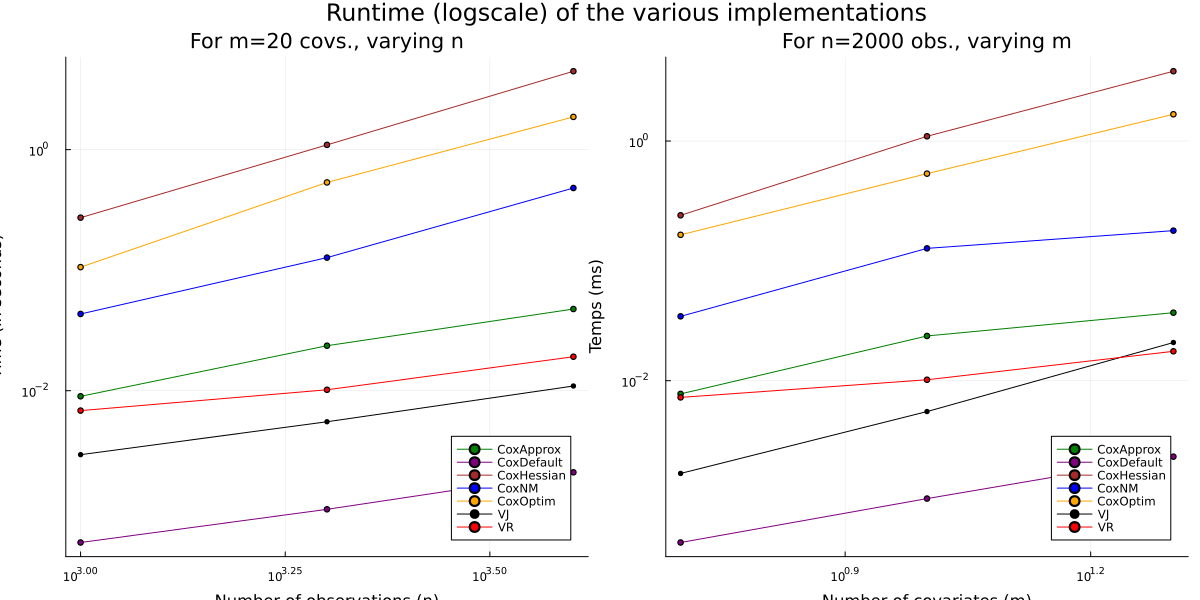
We can the that CoxDefault is the fastest, while CoxHessian is the slowest. We will zoom on our implementation vs Survival.jl vs R::survival:
timing_graph(filter(r -> r.name ∈ ("V4", "V3", "VJ", "VR"), df))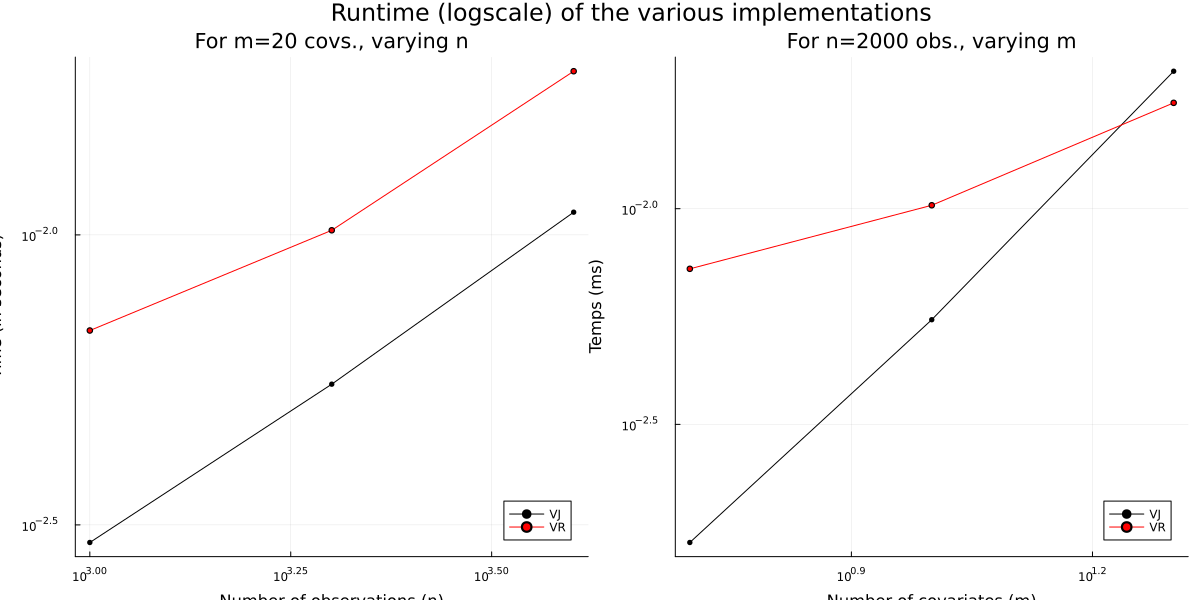
So we are about x10 faster than the reference implementation of R (and than the previous Julia versions) on this example.
function beta_correctness_graphs(df; ref="VJ")

    reflines = filter(r -> r.name == ref, df)
    rename!(reflines, :beta => :refbeta)
    select!(reflines, Not([:name, :time, :diff_to_truth]))
    otherlines = filter(r -> r.name != ref, df)
    rez = leftjoin(otherlines, reflines, on=[:n,:m])
    percent(x,y) = sqrt(sum((x .- y).^2)/sum(y .^2))
    rez.error = percent.(rez.beta, rez.refbeta)
    select!(rez, [:n,:m,:name,:error])
    rez = filter!(r -> !isnan(r.error), rez)

    group1 = groupby(filter(r -> r.m==20, rez), :name)
    p1 = plot(; xlabel = "Number of observations (n)",
                ylabel = "L2dist to $ref's β",
                yscale=:log10,
                xscale= :log10,
                title = "m=20, varying n",
                legend = :bottomright,
                lw = 1);
    for g in group1
        plot!(p1, g.n, g.error, label = g.name[1] , color = design[g.name[1]][2], marker = :circle, markersize = 3)
    end

    group2 = groupby(filter(r -> r.n==2000, rez), :name)
    p2 = plot(; xlabel = "Nomber of covariates (m)",
                ylabel = "L2Dist to $ref's β",
                yscale=:log10,
                xscale= :log10,
                title = "n=2000, varying m",
                legend = :bottomright,
                lw = 1);
    for g in group2
        plot!(p2, g.m, g.error, label = g.name[1] , color = design[g.name[1]][2], marker = :circle, markersize = 3)
    end
    p = plot(p1,p2, size=(1200,600), plot_title="β-correctness w.r.t. $ref's version.")
    return p
end

beta_correctness_graphs(df)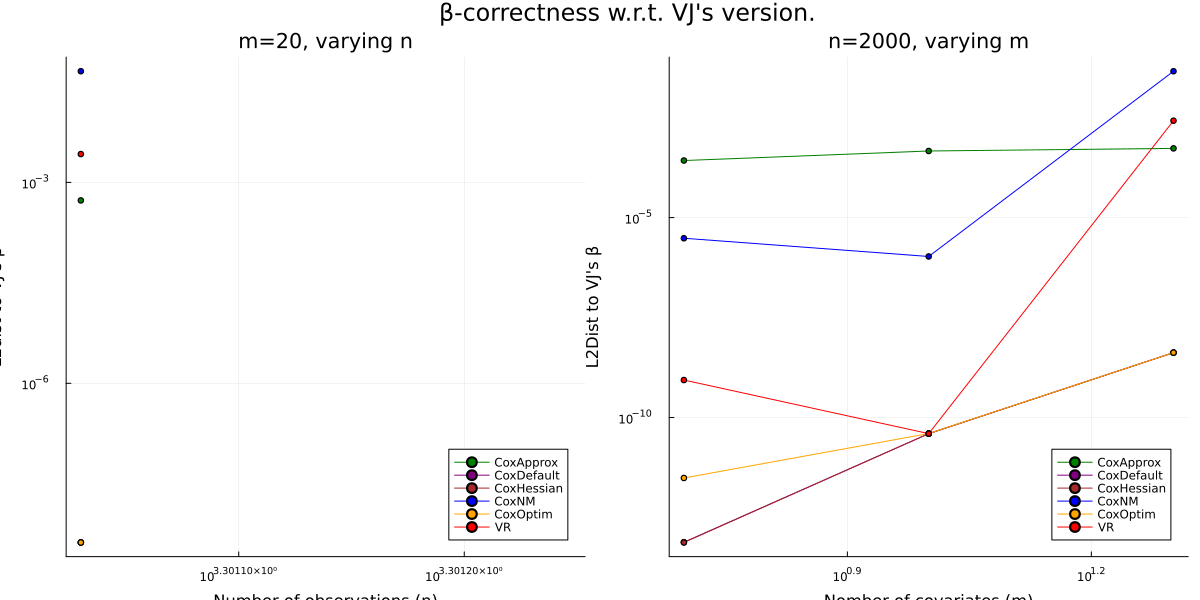
We will compare the diffferent models' coefficents values with the "right" beta value that we obtained while simulating our data.
function beta_wrt_truth(df)
    group1 = groupby(filter(r -> r.m==10, df), :name)
    p1 = plot(; xlabel = "Number of observations (n)",
                ylabel = "L2dist to the truth",
                yscale=:log10,
                xscale= :log10,
                title = "m=20, varying n",
                legend = :bottomright,
                lw = 1,
                plot_title="β-correctness w.r.t. the truth.");
    for g in group1
        plot!(p1, g.n, g.diff_to_truth, label = g.name[1] , color = design[g.name[1]][2], marker = :circle, markersize = 3)
    end

    return p1
end

beta_wrt_truth(df)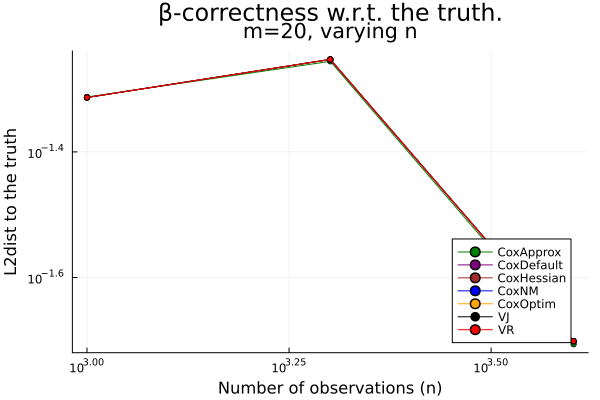
Model Evaluation: Harrell's Concordance Index (C-index)
A key metric for assessing the predictive discrimination of a Cox model is Harrell's concordance index (C-index). The C-index measures the proportion of all usable patient pairs in which the predictions and outcomes are concordant: it is the probability that, for a randomly chosen pair of comparable subjects, the subject with the higher predicted risk actually experiences the event before the other. Tied risk scores count as half-concordant.
SurvivalModels.harrells_c — Function
harrells_c(times, statuses, risk_scores)
harrels_c(C::Cox)
Compute Harrell's concordance index (C-index) for survival models.
Arguments
times: Vector of observed times (Float64).statuses: Vector of event indicators (Bool; true if event, false if censored).risk_scores: Vector of predicted risk scores (higher means higher risk).
Returns
- The C-index, a value between 0 and 1 indicating the proportion of all usable patient pairs in which predictions and outcomes are concordant.
Details
The C-index measures the discriminative ability of a survival model: it is the probability that, for a randomly chosen pair of comparable subjects, the subject with the higher predicted risk actually experiences the event before the other. Tied risk scores count as half-concordant.
You can also call harrels_c(C::Cox) to compute the C-index for a fitted Cox model.
The C-index ranges from 0.5 (no better than random) to 1.0 (perfect discrimination).
You can compute the C-index for a fitted Cox model with harrells_c:
model = fit(Cox, @formula(Surv(Time, Status) ~ Age + Rx), colon)
cindex = SurvivalModels.harrells_c(model)0.5435170918176299A higher C-index indicates better predictive discrimination.
Model Evaluation: Brier Score
The Brier score measures the squared error between predicted survival probabilities and the observed survival status at a chosen evaluation time $t^*$.
Uncensored definition
With every event observed, the Brier score is the mean squared prediction error:
\[BS(t^*) = \frac{1}{n} \sum_{i=1}^{n} \left( Y_i(t^*) - \hat{S}_i(t^*) \right)^2\]
where $Y_i(t^*) = \mathbf{1}(T_i > t^*)$ is the at-risk indicator (1 if subject $i$ is still event-free at $t^*$, 0 otherwise) and $\hat{S}_i(t^*)$ is the model's predicted survival probability for subject $i$ at $t^*$.
IPCW form (Graf et al. 1999)
Under censoring the indicator $Y_i(t^*)$ is unobserved for subjects censored before $t^*$. The standard remedy is the inverse-probability-of-censoring-weighted (IPCW) estimator:
\[\widehat{BS}(t^*) = \frac{1}{n} \sum_{i=1}^{n} \left[ \mathbf{1}(T_i \le t^*, \delta_i = 1) \cdot \frac{\left(0 - \hat{S}_i(t^*)\right)^2}{\hat{G}(T_i)} + \mathbf{1}(T_i > t^*) \cdot \frac{\left(1 - \hat{S}_i(t^*)\right)^2}{\hat{G}(t^*)} \right]\]
where $\hat{G}(t) = \widehat{P}(C > t)$ is the Kaplan–Meier estimator of the censoring survival function (fit on $(T_i, 1 - \delta_i)$). Subjects censored before $t^*$ ($T_i \le t^*, \delta_i = 0$) contribute zero weight.
Integrated Brier score
To summarise the Brier score across a horizon $[0, t_{\max}]$:
\[IBS(t_{\max}) = \frac{1}{t_{\max}} \int_{0}^{t_{\max}} \widehat{BS}(u) \, du\]
Computed by the trapezoid rule on a uniform grid; the $1 / t_{\max}$ normalisation makes the value comparable across horizon choices.
SurvivalModels.brier_score — Function
brier_score(times, statuses, predicted_survival, t)
brier_score(C::Cox, t)
brier_score(C::Cox, ts::AbstractVector)
brier_score(C::Cox, newdata::DataFrame, t)
brier_score(C::Cox, newdata::DataFrame, ts::AbstractVector)
brier_score(m::GeneralHazardModel, t)
brier_score(m::GeneralHazardModel, ts::AbstractVector)
brier_score(m::GeneralHazardModel, newdata::DataFrame, t)
brier_score(m::GeneralHazardModel, newdata::DataFrame, ts::AbstractVector)
Inverse-probability-of-censoring-weighted (IPCW) Brier score per Graf et al. 1999. See the Model Evaluation: Brier Score section of the Cox documentation for the mathematical definition.
The low-level form takes a vector of observed times, an event-indicator vector, a vector of predicted survival probabilities Ŝᵢ(t) ≈ predicted_survival[i], and a scalar evaluation time t. The censoring distribution Ĝ is estimated internally by a KaplanMeier fit on (times, .!statuses).
The C::Cox and m::GeneralHazardModel convenience forms compute the predicted survival via predict(model, :survival, t) on training data, or predict(model, :survival, newdata, t) on new data, then forward to the low-level formula. Vector-ts forms return a Vector{Float64} of Brier scores, one per requested time; the censoring KM is fit once per call.
SurvivalModels.integrated_brier_score — Function
integrated_brier_score(C::Cox; t_max, n_grid=100)
integrated_brier_score(C::Cox, newdata::DataFrame; t_max, n_grid=100)
integrated_brier_score(m::GeneralHazardModel; t_max, n_grid=100)
integrated_brier_score(m::GeneralHazardModel, newdata::DataFrame; t_max, n_grid=100)
Trapezoid-integrated brier_score over [0, t_max], divided by t_max. See the Model Evaluation: Brier Score section of the Cox documentation for the mathematical definition. n_grid controls the resolution of the uniform grid on which the trapezoid rule is applied.
Quick example on the ovarian fixture (continuous covariates):
ovarian = dataset("survival", "ovarian")
model_ov = fit(Cox, @formula(Surv(FUTime, FUStat) ~ Age + ECOG_PS), ovarian)
SurvivalModels.brier_score(model_ov, [100.0, 300.0, 600.0])
3-element Vector{Float64}:
0.03155031037186357
0.03827810386539646
0.1681801847577385SurvivalModels.integrated_brier_score(model_ov; t_max = 800.0)0.1005827059659155- [4]
- D. R. Cox. Regression models and life-tables. Journal of the Royal Statistical Society: Series B (Methodological) 34, 187–202 (1972).